

How Much Time And Money Do People Spend At A Coffee Shop
How would you model the time customers pass in a coffee shop?
This Emily Price Post is light speculation based on no hard data whatsoever, which makes things substantially easier! If anyone has data or suggestions, delight leave a comment. Here goes a first attempt.
The metre people spend in a umber sponsor depends on why they are there.
- Some catch their coffee and pass away.
- Some are there to visit with a champion.
- Some drink their coffee (unparalleled) and leave.
- Some are thither to work.
All group would have its have time distribution, and the overall dispersion would be a mixture of these distributions. Since I'm doing this for fun, I'll ignore (1) and (2) and rightful concentrate along (3) and (4). I'll also ignore complications so much as how patterns change throughout the twenty-four hour period and how they change according to the twenty-four hours of the calendar week.
Say someone comes in alone to give a cup of coffee. Maybe they stay an average of 15 minutes. I'll assume the time these common people spend in a coffeehouse is normally unfocussed. Not many stay more than 30 minutes, so let's say the basic deviation is 5 minutes. That would put merely about 0.4% staying longer than 30 minutes. It would be more realistic to cut short the distribution at zipp to eradicate the miniature probability of spending negative meter in the coffee berry shop (!) and skew the distribution a little to the right, big to a greater extent probability to multitude staying more than 30 minutes.
The mass who hail to the cafe to work stay considerably thirster than the folks who are honorable at that place to drink a cupful of coffee. And their time distribution would be heavily inclined. These folks are farfetched to stay to a lesser degree 30 minutes, and then the distribution would discharge off sharply on the left. There's a wide variety of how long people might bring, so I'd expect a long tail to the right. The reverse da Gamma distribution fits this description. Say there's a 5% chance that a doer will stay to a lesser degree 30 minutes, and a 5% chance they'll stay more than two hours. Using this computer software to solve for parameters, we feel a shape parameter of 6.047 and a scale parameter of 317.3 fits the time distribution in proceedings. This distribution has a contemptible of well-nig 63 transactions, which I suppose is logical.
Here's what the graphs of the two distributions would look like: a symmetric distribution centered at 15 minutes for the drinkers and a skewed distribution centered around 63 minutes for the workers.
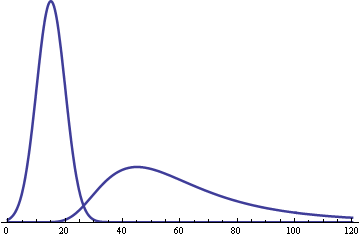
Now suppose 70% of customers are drinkers and 30% are workers. Then the mixture distribution would look like this.
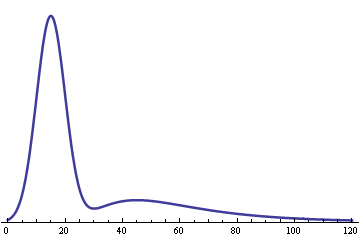
As the percentage of workers goes set, so does the second hump in the graph. If a coffeehouse had about 20% drinkers and 80% workers, the cardinal humps would be about the cookie-cutter height.
How would you include people WHO come to a cafe with a champion?
How Much Time And Money Do People Spend At A Coffee Shop
Source: https://www.johndcook.com/blog/2009/01/21/distribution-of-time-customers-spend-in-coffee-shops/
Posted by: bourgeoisfortall.blogspot.com
0 Response to "How Much Time And Money Do People Spend At A Coffee Shop"
Post a Comment